twitter

Showing posts with label Skillfully Using Mentor Texts. Show all posts

A great lesson is never truly finished.  As with a piece of writing, revision can always improve something--even if it's a pretty good lesson.  I learned that this last month.

I have taken one of my favorite lessons--Extended Metaphors Across the Curriculum--and added some new elements to it, which made my teaching of it better this last month.

One major change I made was that I taught a good friend's lesson (Holly Esposito) the week before I began my writer's notebook lesson.  Her "Four Metaphor Poetry Lesson" (with its use of Mem Fox's Wilfrid Gordon McDonald Partridge) set my kids' brain in the right direction to do so much better with their notebook's metaphors.  This was the best set of metaphors I have ever received in my students' notebooks.  I totally appreciate Holly's lesson as a means of priming my kids' thinking, and I will always use her lesson the week before I introduce the lesson in the future.

I invite you to check out the new version of my Extended Metaphors Across the Curriculum lesson, which features new images of my students' notebooks after these changes.

Always remember...a good lesson (like a good piece of writing) can become better with a thoughtful revision.


Thanks to 7th grader Mitchel (for writing it!) and 8th grader Matt (for illustrating it on my whiteboard!), I have a metaphor of the week in honor of Charley Gordon, main character in Daniel Keyes' Flowers for Algernon, which my 7th graders are currently reading.


The version of the book begins with the following quote from Plato, which we've been using as our "jumping off spot" every time we have had a class discussion about the story's progress.  I chose Mitchel's metaphor this week because it will help us speak one more time about this quote: 

"Anyone who has common sense will remember that the bewilderments of the eye are of two kinds, and arise from two causes, either from coming out of the light or from going into the light, which is true of the mind's eye, quite as much as of the bodily eye; and he who remembers this when he sees any one whose vision is perplexed and weak, will not be too ready to laugh; he will first ask whether that soul of man has come out of the brighter life, and is unable to see because unaccustomed to the dark, or having turned from darkness to the day is dazzled by excess of light. And he will count the one happy in his condition and state of being, and he will pity the other..." Plato, The Republic

Thanks again, Mitchel and Matt!  Have a great week, everyone.  "Meta-Force be with you, students and teachers!"


--Corbett


Only had a few students take me up on January's ANAGRAM CHALLENGE for their writer's notebook.  They loved the mentor text so much, but only a few went online to explore their own anagrams.

This month the challenge is based on creating ORIGINAL SUPERHEROES, and I already have numerous students well under way with the first half of the task.

Check out this book at Amazon by clicking here.


If I were to rate this month's Superhero lesson against my other lessons, I think this one is pretty strong based on two of my seven elements.  The mentor text (Superhero ABC's) is wonderful, and I found a bonus way to use it this last week during 7th grade enrichment, which piqued their interest in the writing assignment more.  We actually diagrammed four or five sentences from the book when I spotted they needed a review of diagramming.


Secondly, my teacher model from my own notebook really grabbed their attention; this lesson has two different notebook pages to create, and it was the first one that seized them.  I am hoping the second one does the same.  Not sure what it is about superheroes that grabs my kiddos' attention, but it does. 

--Corbett


I always had a great time playing with words as a kid, so I experienced fond memories of my childhood this week-end, creating a new teacher-model page in my writer's notebook.  As you probably know if you follow my work, each month I challenge my Gifted & Talented students (I have quite a few this year) and all other students who may be interested in with a special GT Writer's Notebook Challenge of the Month.

My students know how to find my website, and they know where I store these monthly challenges.  They also know that each month I place the "mentor text" that inspired the lesson near my desk, and they can look through the book any time. At the end of the month, students who independently have completed the challenge show it to me for extra credit points and a prize (a comic book or a smencil is what I've offered to them this year).

We were talking about anagrams earlier this month, inspired by the fact that my eighth graders are reading Rocket Boys by Homer Hickam, Jr., and that the movie version of the book is called October Sky--which is an anagram of the original title.  Anyway, my kids became really excited about the notion of making anagrams for their own names and for the names of friends.

I thought anagrams might be an interesting challenge for the next writer's notebook challenge.  After searching for mentor texts on the topic, I discovered a new author/cartoonist: Jon Agee.  He has books on oxymorons, palindromes, and anagrams!  Last week, my new mentor text on anagrams--Elvis Lives! and Other Anagrams came in the mail, and my students went crazy over it.


Saturday morning, I sat down and created a model notebook page on "Personal Anagrams" that I will be showing my students this week--prepping them to think about anagrams while they are away from school over the next few weeks.  Below is the page, which I think turned out great.  I also have the entire lesson write-up for this task completed, and you can access it by clicking here.


Hope you're inspired to anagram too!

--Corbett


I've been looking for an assignment (other than Heart Maps) to launch my writer's notebook program and to give students ownership of their notebooks' ideas.  I finally found a mentor text that inspired a new assignment: Written Anything Good Lately? by Susan Allan and Janet Lindaman.  This simple little alphabet book provides --from A to Z--a variety of writing genre possibilities.  After sharing these authors' alpha-genre list, I've decided I want my students to create one of their own.

Their alpha-genre prompt will be: "Come up with 26 different things you'd be willing to write this year.  Sky's the limit.  Let your creativity fly!  Make sure you only list things you actually have an interest in writing!"

It probably won't surprise you to know that I'm going to base the success of my own lesson on the teacher model I provide.  My teacher model is below.  I am also working with a friend's seventh grade child this summer--Austin--and he'll be creating a model of this notebook page I'll be posting at my online version of this lesson too.

Click here to access my complete online lesson that inspired the above model.
I hope you like this idea enough to say, "I should make my own teacher model of that assignment, so I can show it to my students this Fall."

--Corbett


Our first week back from Northern Nevada Spring Break!

I was out observing at an elementary school yesterday, and I think I saw the more charming thing I've ever seen in a third grade class.  With lyrics in hand and the original playing over the classroom stereo system, the students were singing Katy Perry's "Firework."  They sang it so well, it was clear this was not their first exposure to this song.  And they sang it with such energy; several of the boys were singing it with their eyes closed and swaying their heads as they crooned.

See Firework video here.

The lesson was on figurative language.  The students were raising their right hands when they sang a lyric that was either a simile or a metaphor, and they rasied their left hands when they sang a lyric that had an onomatopoetic word (or two) in it.  I hadn't realized this song had all three figurative elements in it.

Anyway, as one of the co-founders of WritingFix's Song Lyrics as Mentor Texts Lesson Collection, I was naturally charmed by this experience.  It left me with two questions, though:
  1. At what age do these elementary students lose the ability to sing their hearts out like that?  When does "being cool" become more important?
  2. And...What will those kids' parents think the next time they have them riding in the backseat of the car, and that song comes on the radio, and they start raising their left and right hands as they sing along?
Anyway, I'm back from Spring Break and determined to make it through the last eight weeks with a smile on my face.  Remembering those third grade crooners' faces should help!

--Corbett


Are you at a school where not everyone knows about the resources at WritingFix and the Writing Lesson of the Month Network?  If so, why not share the following WritingFix Scavenger Hunt with your K-12 Colleagues.  I designed this activity for a school who asked for a self-guided way to explore the many grade-specific resources at the website.  The activity is designed to take about an hour, through searching, talking about, and sharing unique finds with your colleagues.  It really focuses on the variety of MENTOR TEXTS that can be used when teaching writing.


Click here to open/print this scavenger hunt!

You might consider showing this document to your principals, especially if you have an upcoming collaboration day or professional development.  Enjoy! 

--Corbett


Finally, because I anticipated the participants would ask--especially if I showed them excerpts from two chapter books first--, I showed how analyzing mentor texts could impact primary writers' drafts too. 

An amazing text!
My mentor text of choice for our third activity: All the Places to Love by Patricia MacLachlan.  This beautiful picture book will always make my top ten list of bext mentor texts you can use.  It's both the story of special places and special days, and students can always be asked to write about those topics.  After students have a draft on one of those topics, put it away for a while!  In the gap, read and re-read All the Places to Love several times.  Read it first "As a reader," which means read it to comprehend and enjoy it.  Next, read it "With a Writer's Eyes," which means read it to analyze the writer's skills.  There are so many skills MacLachlan uses that it's hard to pinpoint the best three to put on  my analysis post-it:


In the actual Olympics, often the gap between the gold medal winner and the bronze medal winner is just a fraction of a second.  When analyzing MacLachlan's skills against each other, it feels like they're mostly equal skills, but you've got to challenge your writers--even the young ones--to decide on one of those skills that they feel really shines the most. 

Once students have made that choice, the instruction becomes clear: "When you revise today, you need to try to add the 'gold medal skill' to your sentences."   You can see how that instruction has an impact on the following students' revised drafts about favorite places:

Click here to open/print these primary samples.


And that concludes the three activities I did at this year's Nevada Reading Week.  I can't wait for next year.  Perhaps, there'll be less snow a year from now!

--Corbett


The second activity I did last Friday at the Nevada Reading Week Conference was similar to the first activity, but we used a different mentor text: Marshfield Dreams: When I was a Kid by the great Ralph Fletcher.

I am not shy in saying that I believe this book (especially when you accompany it with Fletcher's How to Write Your Life Story) is the absolute best mentor text to have available when teaching narrative writing with elementary students. I make use of the text every time I work with a group of 4th or 5th graders.

Each chapter of the book is practically its own short story, capturing a real moment from Fletcher's boyhood.  Fletcher doesn't use lofty language like many other authors who write about boyhood; he writes with similes and verbs and adjectives that kids already know.  You don't teach vocabulary with this book; you teach students about skillful writing because this book is skillfully penned. 

On Friday, we read one of the shortest chapters from the book, which is called "First Pen."  It's about a gift that young Ralph received that meant a lot to him.  This chapter is so short, if you hand-wrote it out on Nevada's Writing Test Form, it would just fit.  To me, it's the perfect example of short, effective narrartive writing.

I can't legally post the entire chapter for you here, but I can show you two fourth grade samples that tried to imitate Fletcher's style as they wrote short narrative about important gifts they had received.  If you have a copy of Marshfield Dreams--or if you obtain one--spend some time comparing what these two fourth graders did with their writing that Ralph Fletcher also did!  Because they analyzed the writing (using the Post it below) they could do so much more than just impersonate the idea.

Click here to open/print these student samples!

Finally, below is the Post-it I designed to have the participants analyze and evaluate Fletcher's skills in the "First Pen" chapter!


I'll be posting my third and final activity from last Friday tomorrow!


Over the next few days, I will be posting the three activities I did during last week-end's Nevada Reading Week Conference.


Nevada's Ellen Fockler
 My dear colleague, Ellen Fockler, has faithfully coordinated this conference for...I don't know how many years now.  It started last Friday night, and despite an insane amount of snowfall in the hours that led up to the start time, it was well-attended...as usual.

When Ellen asks me to present year after year, I just can't say no; she's a Northern Nevada treasure, loved by our librarians, and as a guy who loves to share writing lessons inspired by mentor texts, NRW is a great place for me to share some of my newest wares.

This year's presentation, inspired by my work with our State Common Core Standards, was called "Reading with a Writer's Eye."  When we read a mentor text, we must first "Read it like a reader," which I explained means we read it to comprehend it.  Later--perhaps a few days, in fact--we can re-read the same text "with a writer's eyes," which means we look at its specific skills and writing tricks the author used to make the writing stand out.

To "read like a writer" requires us to arm our students with tools of analysis and evaluation; from my observations of reading and writing instruction--and this is not an insult, it's a fact--teachers mostly push students to the comprehension level or the application level.  I rarely see reading/writing instruction that pushes the students to analyze or evaluate what they're reading and writing.  Common Core State Standards are really going to surprise our teachers who think they're not that different from the current Nevada Standards.

And so...my NRW presentation introduced some new tools that require readers to analyze and evaluate mentor texts, and then we saw how student writers--when they've learned to do this--can imitate the writing style in original pieces of writing.

We started with this chapter three excerpt from Blue Balliett's Chasing Vermeer:

The 5:38 southbound train went by Petra’s window exactly three second before it passed Calder’s.  In between, in shot by the Castiglione’s and then the Bixby’s—Petra had once calculated that it passed a house per second on Harper Avenue.  She liked the trains.  Looking out, she saw the bright shout of a red hat, a child in a purple jacket pressed against the window, a bald head just rising over the stiff rectangle of newspaper.  She’d noticed that colors sometimes left their shapes when things flashed by so fast.

After we discussed the context of the excerpt and all comprehended the writing, we used the following Post-it to analyze and evaluate it.  With partners, they re-read the text and decided which of the three skills listed on the Post-it stood out the strongest (gold medal), the second strongest (silver), and third strongest (bronze).  As the adults began disagreeing with one another's rankings, I knew they were achieving the analysis and evaluation level:


Of course, there's no right answer to the rankings; it's a very subjective task, as is responding to the style of any piece of writing.  When I use these analysis Post-its with students, I ask them to find the answer they believe in and--when they write for me--try to imitate the skills they believe were at the "Gold Medal" level.

It works.  It makes students more aware of the strength's of good writing.  You can see evidence of imitated skills in this piece by a fourth grader who was challenged to write about something that also moves fast--like the train in the mentor text:


Click the story above to see it in larger form!

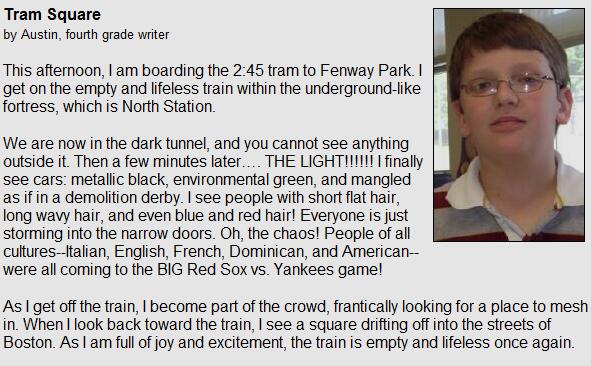
When we analyze text, when we read with a writer's eyes, we can be influenced to write using the skills of our favorite authors.  This is made clear to me by Austin's sample!

Tomorrow, I'll be posting the second activity I did during my Friday night session at Ellen's Nevada Reading Week Conference.

--Corbett


This post is fueled by two of my Seven Elements of a Differentiated Writing Lesson:  1) Mentor Texts and 2) Helping Students Discuss Writing at the Ananysis & Evaluation Level
I am on a quest this year!  I want to create a library of amazing mentor texts to use when teaching expository writing.  They're proving hard to find.

A mentor text--as you probably already know--is a published piece of writing whose idea, whose structure, or whose written craft can be analyzed during a lesson to inspire your own students to write.

Narrative and persuasive mentor texts are no problem to find.  Why is it so difficult to find a published piece of expository writing that I can use to inspire my own students' expository assignments?

I've begun my search.  Before Winter Break, I crafted a new demonstration lesson that focused on revision skills for this expository prompt: explain how to play a game to someone who doesn't know how to play it.  I was thrilled to find The Dangerous Book for Boys gathering dust on my bookshelf.  It had voice-y explanations for playing games that ended up working really well when I taught the lesson to eighth graders.

My lesson based on this mentor text has been posted at WritingFix.  Click here to access it. 

One of my lesson's strengths, I believe, is the student discussion tool I created to go with it.  It has student writers analyze the mentor text's voice skills for practice, then analyze the same voice skills in their own rough drafts.

I honestly believe when you have a good mentor text top start with, it's fairly easy to foster a discussion about the writing skills the author has used.  Having students "rank" a mentor text's skills against themselves as a comparative thinking task immediately pushes students to a deeper level of Bloom's taxonomy.  Take a good look at my lesson to see how I have the students "rank" and discuss writing skills as part of the lesson.

IF YOU HAVE A MENTOR TEXT FOR EXPOSITORY WRITING THAT YOU'VE HAD SUCCESS WITH, PLEASE SHARE THEM WITH ME!

--Corbett