twitter

Showing posts with label Discussing Writing Samples at the Analysis and Evaluation Level. Show all posts

My older brother Andy's birthday is this week, and I felt we needed an odd metaphor to celebrate the event. Not that he's odd, but not that he's normal either; none of us Harrisons are all that normal, which is a good quality, I feel.

I decided to take a metaphor of the week--in honor of all that--from one of my favorite non-normal students--Jordan, who is in seventh grade.  Jordan is an incredible young man who can amazingly build anything out of a piece of construction paper.  He tried to start an Origami Club this year, but no one else seemed interested.  I told him that--based on his amazing creations this year (his stereo-optic viewing box for one of his essays, his pet construction paper Phoenix that actually flaps its wings, etc.) that we will make sure his club "flies" next year.  I told him he could make a fortune selling fellow students replicas of his Phoenix; it's quite incredible.

Anyway, Jordan, you are this week's "Metaphor of the Week" winner, and I love the weirdness of your metaphor.  You explore things with such interesting perspectives, and I am proud your metaphor shows that.  Good work, my young writer and friend.


--Mr. Harrrison


Our March Writer's Notebook Bingo Cards "Center-Square Lesson" was entitled "Rhyming Slogans Across the Curriculum."  I quickly discovered which of my students rhyme easily and which students can hardly rhyme to save their lives.  All in all, it was a fun month though...even for those who struggled.

I just published ten fun examples from (mostly) my seventh grader's notebooks.  I'm not sure why the sixth and eighth graders' pages were so "less than stellar," but they were.  I've challenged them to outshine every seventh grader with April's notebook challenge.

Please feel free to visit my Rhyming Slogans Across the Curriculum Student Samples Page to see the wonderful work my students do.  Next year, to have my notebook and ten pages from these students to show next year's students...well, I can hardly wait to teach this lesson again next spring; the more samples you have to share, I have found, the better off the lesson is.  I believe this whole-heartedly.

Here is one of my favorite samples, from my wonderful student, Wonje:


--Corbett


A teacher once told me he was able to teach the six writing traits in a week.  I acted impressed, but I wasn't really.  I have to wonder at what cognitive level he was teaching them if he could be done in a week.

In my classroom, the language of the writing traits is the most important academic language I give my students.  Without it, my students' ability to talk about quality writing versus average writing would not exist.  Of all the academic vocabulary I give my students, the traits language is the most important.

Each trait has its own academic vocabulary associated with it.  When you really teach idea development, your students are learning multiple things: relevant details, topic, showing, imagery, main idea, subtopic, etc.  There is no way you could really teach the six writing traits in a week. 

In my classroom, I have a "Trait of the Month" bulletin board.  Once a month it changes, but only after we have had dozens of discussions and mini-lessons focused on that trait.  Even with a month, my students discover they still have much more to learn about how to use/improve upon each writing trait.

I don't ever use conventions as the "Trait of the Month."  Conventions is always in the background when we work on the writing process.

I've decided this year--because SHOWING writing is going to be one of my focuses--that we will use Idea Development as September's Trait, Word Choice as October's Trait, and Voice will be November's Trait; these are the three traits most needed when learning to "Show instead of tell."

Above, you can see my just-hung "Trait of the Month" bulletin board.  It not only features one of trait posters I purchased through Amazon, but it also features the idea development chart from WritingFix's Building with the 6 Traits poster set, and various student samples I found at WritingFix that were strong with their use of idea development skills.  The question at the bottom of the bulletin board asks students to analyze those student samples, looking for specific idea development skills that the writers excelled with.

My classroom copy of "Show; Don't Tell" will be displayed in the near-by chalk tray near the bulletin board for September-November!


I'm spending the next two days hammering out end-of-year materials for our Northern Nevada Differentiated Instruction Program: The Student Learning Facilitator (SLF) Program.  As soon as Wednesday night's portfolio celebration is completed, I am full-time committed to finishing our new Expository Print Guide for 6th - 8th grade teachers.

Yesterday, between SLF observations, I managed to complete the second set of 6th grade "sparklers," which puts the sixth grade section of the guide very close to completion.  This set of Sparklers was based on this practice prompt:  Ever since the cave man invented fire and the wheel, people have been inventing things to move us forward.  What invention do you think has been the most important?  Explain your answer with relevant, showing details.

Click here to open this 6-page document of 6th grade Sparklers
Keep watching for new postings after Wednesday night...they should be coming fast and regular now.

--Corbett


Working with a crazy deadline here!  We put out the "Show Me Your Story" Narrative Print Guide in April, and before June, we're trying to assemble all our Expository materials into a new-but-similar guide for our 6th-8th grade teachers.  We have money set aside to print an expository guide for every Northern Nevada 6th-8th grade teacher, but that money goes away on July 1st...Deadlines can be stressful.  Especially when I have so many other things I'm working on.

It's no secret that one of my favorite authors for teachers in the amazing Gretchen Bernabei.  Her collection of essays called "Sparklers" really shaped my thinking as I coordinated both the narrative guide and this new expository guide.  Gretchen's book contains student samples from all over the country that scored well on state writing tests, and they're presented in a way that they require students to critically think as they examine the strengths of these student essays.

In Northern Nevada, we have designated narrative and expository practice prompts that we hope our teachers--indeed--practice with, and many of them do.  Gretchen's book inspired me to create a set of Nevada Sparklers for all our designated practice prompts.  It's turned out to be a little bit of a chore, but we are almost 100% there.  The last two sets are for the expository guide's 6th grade practice prompts.

Hooray! I finished the first set this afternoon.  6 charming essays by six charming Nevada kids who practiced with this prompt:  It may be fun to be someone else for a while.  If you could change places with someone, who would you choose?  Explain your choice.

I hope you enjoy these six "sparkling" samples.  And I hope you'll notice the "Interactive Challenge" below each sample, which are designed to get other writers to apply critical thinking skills to their own expository drafts.

Click here to open/print this 6-page document


Most of all, thanks Gretchen Bernabei.  When I grow up, I want to be you!

--Corbett


I was so inspired by Gretchen Bernabei's collection of high-scoring student essays in her book, Sparklers, that two years ago, I began my own project based on the book's theme: what can we learn from essays by students that score well?  Here's a quick history lesson of that project and access to the final set of Sparkler below my brief history.

In Nevada, we urge both our fourth and fifth grade teachers to use the six practice prompts we've designated for them.  Even though on-demand prompt writing isn't the most authentic type of writing instruction we can provide our students, it's necessary in order for our students to understand how the fifth grade writing test will assigned to them and assessed. 

I strongly urge against "cramming" for the test in the weeks before the exam happens (in January), but plenty of local administrators still spend December having their teachers assign a practice prompt a week.  Sigh.  This does little more than exhaust and turn kids off of writing.  You've got to start prepping much earlier, and you've got to spread it out to keep students interested in it!

I urge fourth and fifth grade teachers to designate three months out of the school year to narrative.  For a week, students should work on a practice prompt, learning pre-writing and revision skills as they go.  Then for three weeks after that, the teacher should teach an authentic narrative writing lesson so as to solidify those prewriting and revision skills in students' tool boxes.  Fifth grade should put their three months of narrative practice and learning in the Fall.  Fourth should do it in the Spring.

At WritingFix, we post great materials to help teachers assign and assess these practice prompts.  One of the tools we post to make sure teaching happens (not just assessing) during the practice prompts is our own set of Nevada Sparklers.  I wanted there to be at least four sparkling samples for teachers to use during pre-writing and revision; I wanted these "Sparklers" to be on the same prompts we had our students practice to in Nevada.

I took over two years, but we now have 4 "Sparklers" for all 6 of our designated practice prompts.  The final set was just added this last week as part of my narrative project; it was four fourth grade.  Earlier on this blog, I posted the video I sent to the class of fourth graders I worked with to obtain these samples; I also posted a very sweet sample from a student--Kaya--who didn't get chosen as a Sparkler, but wrote a sweet little piece about me.  I hope you saw both those posts!

The prompt the final set of Sparklers is based on was: If you could give a special gift or award to a deserving person, what would it be and why? Share reasons and details as you compose your answer.

The final set of Sparklers is now posted at our newly-revised  Narrative Homepage.  They look like this:
Click here to access/print all four Sparklers from our last set!

Next up: Sparklers for our brand new 6th grade Expository Prompts!  The work never ends!  Have a great week!


Finally, because I anticipated the participants would ask--especially if I showed them excerpts from two chapter books first--, I showed how analyzing mentor texts could impact primary writers' drafts too. 

An amazing text!
My mentor text of choice for our third activity: All the Places to Love by Patricia MacLachlan.  This beautiful picture book will always make my top ten list of bext mentor texts you can use.  It's both the story of special places and special days, and students can always be asked to write about those topics.  After students have a draft on one of those topics, put it away for a while!  In the gap, read and re-read All the Places to Love several times.  Read it first "As a reader," which means read it to comprehend and enjoy it.  Next, read it "With a Writer's Eyes," which means read it to analyze the writer's skills.  There are so many skills MacLachlan uses that it's hard to pinpoint the best three to put on  my analysis post-it:


In the actual Olympics, often the gap between the gold medal winner and the bronze medal winner is just a fraction of a second.  When analyzing MacLachlan's skills against each other, it feels like they're mostly equal skills, but you've got to challenge your writers--even the young ones--to decide on one of those skills that they feel really shines the most. 

Once students have made that choice, the instruction becomes clear: "When you revise today, you need to try to add the 'gold medal skill' to your sentences."   You can see how that instruction has an impact on the following students' revised drafts about favorite places:

Click here to open/print these primary samples.


And that concludes the three activities I did at this year's Nevada Reading Week.  I can't wait for next year.  Perhaps, there'll be less snow a year from now!

--Corbett


The second activity I did last Friday at the Nevada Reading Week Conference was similar to the first activity, but we used a different mentor text: Marshfield Dreams: When I was a Kid by the great Ralph Fletcher.

I am not shy in saying that I believe this book (especially when you accompany it with Fletcher's How to Write Your Life Story) is the absolute best mentor text to have available when teaching narrative writing with elementary students. I make use of the text every time I work with a group of 4th or 5th graders.

Each chapter of the book is practically its own short story, capturing a real moment from Fletcher's boyhood.  Fletcher doesn't use lofty language like many other authors who write about boyhood; he writes with similes and verbs and adjectives that kids already know.  You don't teach vocabulary with this book; you teach students about skillful writing because this book is skillfully penned. 

On Friday, we read one of the shortest chapters from the book, which is called "First Pen."  It's about a gift that young Ralph received that meant a lot to him.  This chapter is so short, if you hand-wrote it out on Nevada's Writing Test Form, it would just fit.  To me, it's the perfect example of short, effective narrartive writing.

I can't legally post the entire chapter for you here, but I can show you two fourth grade samples that tried to imitate Fletcher's style as they wrote short narrative about important gifts they had received.  If you have a copy of Marshfield Dreams--or if you obtain one--spend some time comparing what these two fourth graders did with their writing that Ralph Fletcher also did!  Because they analyzed the writing (using the Post it below) they could do so much more than just impersonate the idea.

Click here to open/print these student samples!

Finally, below is the Post-it I designed to have the participants analyze and evaluate Fletcher's skills in the "First Pen" chapter!


I'll be posting my third and final activity from last Friday tomorrow!


Over the next few days, I will be posting the three activities I did during last week-end's Nevada Reading Week Conference.


Nevada's Ellen Fockler
 My dear colleague, Ellen Fockler, has faithfully coordinated this conference for...I don't know how many years now.  It started last Friday night, and despite an insane amount of snowfall in the hours that led up to the start time, it was well-attended...as usual.

When Ellen asks me to present year after year, I just can't say no; she's a Northern Nevada treasure, loved by our librarians, and as a guy who loves to share writing lessons inspired by mentor texts, NRW is a great place for me to share some of my newest wares.

This year's presentation, inspired by my work with our State Common Core Standards, was called "Reading with a Writer's Eye."  When we read a mentor text, we must first "Read it like a reader," which I explained means we read it to comprehend it.  Later--perhaps a few days, in fact--we can re-read the same text "with a writer's eyes," which means we look at its specific skills and writing tricks the author used to make the writing stand out.

To "read like a writer" requires us to arm our students with tools of analysis and evaluation; from my observations of reading and writing instruction--and this is not an insult, it's a fact--teachers mostly push students to the comprehension level or the application level.  I rarely see reading/writing instruction that pushes the students to analyze or evaluate what they're reading and writing.  Common Core State Standards are really going to surprise our teachers who think they're not that different from the current Nevada Standards.

And so...my NRW presentation introduced some new tools that require readers to analyze and evaluate mentor texts, and then we saw how student writers--when they've learned to do this--can imitate the writing style in original pieces of writing.

We started with this chapter three excerpt from Blue Balliett's Chasing Vermeer:

The 5:38 southbound train went by Petra’s window exactly three second before it passed Calder’s.  In between, in shot by the Castiglione’s and then the Bixby’s—Petra had once calculated that it passed a house per second on Harper Avenue.  She liked the trains.  Looking out, she saw the bright shout of a red hat, a child in a purple jacket pressed against the window, a bald head just rising over the stiff rectangle of newspaper.  She’d noticed that colors sometimes left their shapes when things flashed by so fast.

After we discussed the context of the excerpt and all comprehended the writing, we used the following Post-it to analyze and evaluate it.  With partners, they re-read the text and decided which of the three skills listed on the Post-it stood out the strongest (gold medal), the second strongest (silver), and third strongest (bronze).  As the adults began disagreeing with one another's rankings, I knew they were achieving the analysis and evaluation level:


Of course, there's no right answer to the rankings; it's a very subjective task, as is responding to the style of any piece of writing.  When I use these analysis Post-its with students, I ask them to find the answer they believe in and--when they write for me--try to imitate the skills they believe were at the "Gold Medal" level.

It works.  It makes students more aware of the strength's of good writing.  You can see evidence of imitated skills in this piece by a fourth grader who was challenged to write about something that also moves fast--like the train in the mentor text:


Click the story above to see it in larger form!

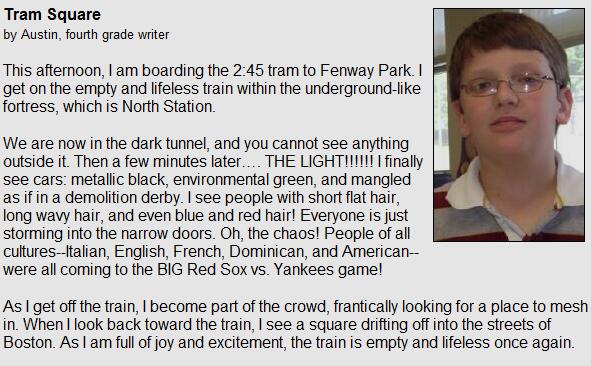
When we analyze text, when we read with a writer's eyes, we can be influenced to write using the skills of our favorite authors.  This is made clear to me by Austin's sample!

Tomorrow, I'll be posting the second activity I did during my Friday night session at Ellen's Nevada Reading Week Conference.

--Corbett


It may appear that I'm slacking off of my "Keep a Blog as my New Year's Resolution," but I really haven't been.  Honest.

 The NNWP has me on a tight deadline for having our newest 300+ page print resource to the editor this month so it can go to the printer in early March.  The Guide--"Show Me Your Story"--focuses on narrative lessons and teaching strategies, especially aimed at 3rd-5th grade.  The fourth grade section is now completely done!  Woo-hoo!  Coming soon (to the editor) the 3rd and 5th grade section.  This is what I have been working on.  See?  Not slacking!

Let me share from the now-completed fourth-grade section for the new guide.  Here's a link to one of the pre-writing lessons that will appear both online and in the guide:  http://writingfix.com/Process/PreWriting/Showing_Pride_4th.htm

This is a pre-writing lesson that teaches skills necessary to narrative writing.  It focuses nicely on three of my seven elements of a differentiated writing lesson: graphic organizers, student talk about student samples, and  student choice.

Take a few minutes to explore for those three elements in the thorough online write-up.  Did any new ideas occur to you?


I've been doing demonstration lessons with fourth graders this last week; tomorrow, I start working with the sixth graders for samples.  We're gathering student samples to be used as discussion tools in the NNWP's new Narrative Writing Resource, which comes out this March!  It's going to be a fantastic new resource guide.

The prompt I was working with when I met with the fourth graders (see the video in the previous post) was "If you could give a special award to a deserving person, what would it be and why would that person deserve the award?"  I ran the event as a little "contest," saying the winners would be featured in the new guide, which was a great motivator.
I got great samples from such a wonderful group of kids; I am sure showing them the video long before they began writing was really instrumental in receiving so many fun samples.  I'm adding this technique to my bag of tricks.

Here's one we didn't select as a "winner," but it's one of my favorite samples from the bunch.  I love Kaya's introduction more than anything.  :-)


The Best Male Writing Teacher Award
by Kaya, fourth grade writer

Have you ever thought that you’ve met the best male writing teacher in the world, and your friend thought the opposite?  Well, that’s called an opinion and this is my opinion on who the best male writing teacher in the world is…Mr. Harrison. 

The number one reason that I’d give the award “Best Male Writing Teacher in the World” to Mr. Harrison is because he gives great ideas to grown ups and kidsas well.  Once in Mrs. Espinosa's Class, he gave great ideas on what to write about for this awards assignment, which is what I’m writing about now.  He even has this website that teachers can go on to find a fun assignment for their classes.

The second reason Mr. Harrison should get this award is that he goes over a lot of ideas in his head before he decides what he is going to write about.  Like the time he wrote about four characters he wanted to put into stories.  He spent a long time just thinking about what their names were going to be.

I’d give this award to Mr. Harrison because it's my opinion on who the "Best Male Writing Teacher in the World" is.

Thanks, Kaya...I think you've got a charming writing style, and you know how to choose a great topic.  What advice would you give this young charmer for making her next draft even better?


I'm probably biased, I'm sure; I really love my Seven Elements of a Differentiated Writing Lesson.  It's a framework I use in all my trainings now.  It's designed to inspire writing teachers to think about what they're already doing well to help all learners become better writers, as well think about what they could be doing better.  We could all be doing things better.  Great writing instruction is a life-long learning topic for teachers, if ever there was one.

I've been working as one of the coordinators of the Northern Nevada Writing Project's next great print resource: Teaching Narrative Writing.  The guide will contain a great variety of mini-lesson-inspired resources as well as ten complete lessons on teaching narrative/descriptive writing in elementary school.

The guide, which comes out this March, is being marketed as a tool for collaborative teaching teams, and the ten lessons are included to inspire great conversation among like-minded teachers.  To help guide the conversation, we've decided my Seven Elements framework will be the basis of the discussion the guide is trying to promote.  Each of the ten lessons in the guide (like the one pictured above) will feature a discussion prompt (see the gray box) that asks teachers to think specifically about the seven elements.

Here is a draft just one of the ten lessons being featured in the guide.  Feel free to print it and apply the Seven Elements discussion prompt to the entire lesson.  I think you'll see the power of the Seven Elements as a discussion tool.

In particular, with this lesson, notice that its strength really lies with its three grahic organizers and the way we designed the student samples to serve as discussion tools!
--Corbett


This post is focused on one of The Seven Elements of a Differentiated Writing Lesson from my workshop on that topic: Discussing Writing Samples at the Analysis and Evaluation Level

I worked with the whole staff at one of my focus schools yesterday.  Back in November, each grade level had chosen and collaboratively been adapting lessons from WritingFix.  They had arrived at a place where most of them had published student samples from that collaboration.

I designed a guided meeting for them to discuss some of my preferred techniques for prompting students to discuss other students' writing samples.  Here is the packet we used yesterday during this meeting.

Now my personal goal, when having students discuss a student model as part of the writing process, is to have the students attempt to use the higher verbs from Bloom's taxonomy; in particular, analyze and evaluate. 

When you read like a reader, you read to comprehend and to hopefully enjoy the text.  When you read like a writer, which is what I strive to help my students do, you are analyzing and evaluating the writing skills an author has used.  By thinking about writing skills at a deep level of Bloom's, you are helping students to understand those skills enough to try them in their own drafts or revisions.

So...back to my packet from yesterday; it has four pages, and below I'll explain what we did with each page:

  1. First, we read Jack and Megan's first grade samples from WritingFix's Cloudy With a Chance of Meatballs lesson.  I asked the grade level teachers make lists, in student-friendly terms, of organization and word choice skills that students could refer to so that they could determine which trait skills the writers did their best work with (as the discussion prompt at the top of the page asks them to do.) 
  2. Next, we read fourth-grader Beau's narrative practice prompt, "The Hike."  This particular sample is one of the sparkling examples of on-demand prompt writing we feature at WritingFix's Nevada Writing Test Homepage.  Each of our posted "Sparklers" comes with an interactive task (at the bottom) that requires the students to analyze the writer's skills and think how they might apply that skill to their own practice prompt writing.  With Beau's example, I particularly like how the students are asked to compare one part of Beau's writing to another part.  In order to analyze or evaluate, it's often necessary to have two samples; in this case, one sample will do if you have the students make a comparison inside a single essay or piece of writing.  Pretty smart, right?
  3. After Beau's sample, we looked over Justin and Joshua's short pieces of finalized writing; both are inspired by WritingFix's Caves lesson, which is one of my own original lessons!  I observed a teacher do a whole-class Venn diagram when having her students analyze two student samples a while back, and I thought it was a brilliant strategy.  I replicated her idea in the middle of the Justin/Joshua handout, and I had the teachers actually go through the process with their grade levels yesterday.  The discussions I overhear while they complete the Venn are always full of trait language and completely at the analysis level.  Comparing & contrasting is a marvelous way to strengthen your intended Bloom's verb.
  4. Finally, we looked at three high school samples, which are also based on the Caves lesson.  When you have three quality samples to discuss, you can create a discussion prompt using one of my own inventions: The Olympic Committee Task. It's explained in detail at the bottom of my handout's fourth page, so I won't rehash what it says here in the post.  After Olympic Committee-ing the three high schoolers, we returned to Jack and Megan's samples on the first page, and I asked, "How might you adapt the Olympic Committee Task to work with these two much younger writers?"
Our guided meeting ended with me asking the teachers to save enough student samples to create interesting discussion prompts to use in the future.

--Corbett


This post is fueled by two of my Seven Elements of a Differentiated Writing Lesson:  1) Mentor Texts and 2) Helping Students Discuss Writing at the Ananysis & Evaluation Level
I am on a quest this year!  I want to create a library of amazing mentor texts to use when teaching expository writing.  They're proving hard to find.

A mentor text--as you probably already know--is a published piece of writing whose idea, whose structure, or whose written craft can be analyzed during a lesson to inspire your own students to write.

Narrative and persuasive mentor texts are no problem to find.  Why is it so difficult to find a published piece of expository writing that I can use to inspire my own students' expository assignments?

I've begun my search.  Before Winter Break, I crafted a new demonstration lesson that focused on revision skills for this expository prompt: explain how to play a game to someone who doesn't know how to play it.  I was thrilled to find The Dangerous Book for Boys gathering dust on my bookshelf.  It had voice-y explanations for playing games that ended up working really well when I taught the lesson to eighth graders.

My lesson based on this mentor text has been posted at WritingFix.  Click here to access it. 

One of my lesson's strengths, I believe, is the student discussion tool I created to go with it.  It has student writers analyze the mentor text's voice skills for practice, then analyze the same voice skills in their own rough drafts.

I honestly believe when you have a good mentor text top start with, it's fairly easy to foster a discussion about the writing skills the author has used.  Having students "rank" a mentor text's skills against themselves as a comparative thinking task immediately pushes students to a deeper level of Bloom's taxonomy.  Take a good look at my lesson to see how I have the students "rank" and discuss writing skills as part of the lesson.

IF YOU HAVE A MENTOR TEXT FOR EXPOSITORY WRITING THAT YOU'VE HAD SUCCESS WITH, PLEASE SHARE THEM WITH ME!

--Corbett